

Commercial moving is the professional relocation of a business, office, institution or specialized workplace. Unlike a residential move, it must protect business continuity as well as physical property. Furniture, technology, records and specialty equipment have to reach the correct destination while employees, customers and critical systems experience as little disruption as possible.
For New York businesses, that work also involves freight-elevator schedules, loading docks, certificates of insurance, building protection and traffic constraints. This guide explains what commercial moving includes, how the process works and what to look for when selecting a relocation partner.
What Does Commercial Moving Include?
A commercial move can range from relocating a small office to coordinating a multi-floor corporate headquarters, laboratory, healthcare facility, hotel or warehouse. The service is built around a detailed plan rather than simply loading and unloading furniture.
Depending on the project, commercial moving services may include:
- Pre-move surveys, budgeting and relocation planning
- Building coordination and certificate-of-insurance management
- Packing, labeling and reusable moving-bin programs
- Office furniture disassembly, transport and reinstallation
- Computer, server and technology relocation
- File, library, artwork and specialty-equipment handling
- Short- or long-term commercial storage
- Furniture delivery, installation and office liquidation
- Post-move support and final space closeout
Commercial Moving vs. Residential Moving
Residential and commercial moves both require careful handling, but the operating priorities are different. A household move focuses on personal belongings and a family timeline. A business move must coordinate departments, vendors, building managers, technology teams and employees around firm operational deadlines.
Commercial projects often involve detailed floor plans, destination codes, asset inventories and phased schedules. They may need to happen overnight or during weekends so the company can reopen for business on time. The mover must also understand how to protect confidential records, sensitive electronics, modular furniture and specialized equipment.
How the Commercial Moving Process Works
1. Site Survey and Scope
The process begins with surveys of the origin and destination. The moving team documents inventory, access routes, elevators, loading areas, required building protection and any assets needing special handling. The survey becomes the basis for the crew plan, equipment needs, schedule and estimate.
2. Relocation Plan and Timeline
A project manager builds a schedule connecting packing, furniture, technology, construction and building access. Each phase should have a clear owner and completion standard. For a complex project, the plan may divide the move by floor, department or business function.
3. Inventory, Labeling and Destination Planning
Every office, workstation, room and storage area receives a destination code. The same code appears on furniture, cartons, equipment and destination signage. This system lets crews place assets correctly without relying on employee names or verbal directions.
4. Packing and Asset Protection
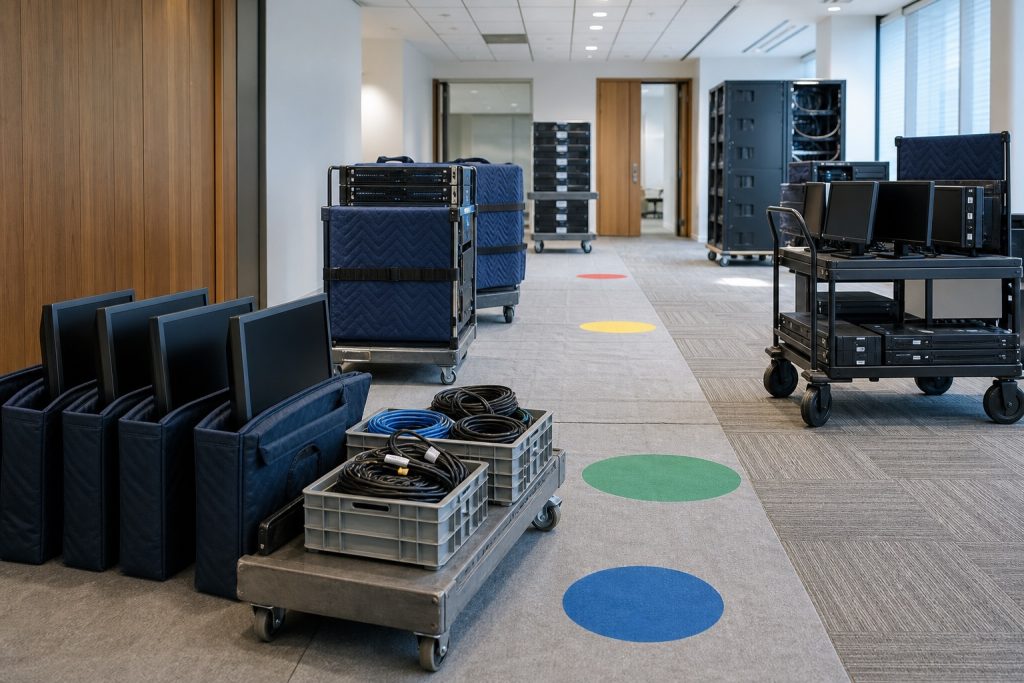
Reusable crates, computer bags, rolling carts, protective padding and floor coverings keep assets and buildings safe. Confidential files and high-value equipment may require controlled handling, documented custody or customized packing methods.
5. Move Execution
Commercial moves are frequently scheduled after hours. The project manager coordinates crews, vehicles, elevators and destination readiness in a planned sequence. Progress is tracked by phase, and exceptions are escalated to the designated decision-maker.
6. Setup and Post-Move Support
At the destination, furniture and equipment are placed according to the approved plan. Teams verify workstation placement, common areas, technology readiness and safe access before employees return. A final walkthrough identifies adjustments and closes out the former space.
What Types of Businesses Need Commercial Movers?
Any organization moving business assets can benefit from a professional commercial moving plan. Common projects include:
- Corporate offices and headquarters
- Law firms and financial-services companies
- Healthcare practices and laboratories
- Schools, libraries and nonprofit organizations
- Retail stores, hotels and hospitality properties
- Technology companies and data-intensive workplaces
- Warehouses, showrooms and furniture inventories
Each environment has different operational risks. A law firm may prioritize file security, while a laboratory may require specialized handling and a technology company may focus on network downtime. The relocation plan should reflect those requirements.
How Much Does Commercial Moving Cost?
Commercial moving costs depend on inventory, labor, distance, access conditions and the services included. Major cost factors include the number of workstations, furniture disassembly, packing needs, technology handling, elevator availability, after-hours requirements, storage and the number of move phases.
A site survey produces a more useful estimate than a simple square-foot calculation. Businesses should also budget for related work such as IT support, furniture installation, building protection and disposal. For more detail, see Eagle Transfer’s guide to office relocation costs in Manhattan.
How to Choose a Commercial Moving Company
Look for a mover with relevant business-relocation experience, documented project-management processes and the resources to handle your schedule. Before selecting a partner, ask:
- Have you completed moves of a similar size and business type?
- Who will manage the project from planning through closeout?
- Can you meet both buildings’ insurance and access requirements?
- How will furniture, technology and confidential assets be protected?
- Can you provide storage, installation or liquidation if the schedule changes?
- How will progress, exceptions and last-minute changes be communicated?
The lowest estimate is not always the lowest total cost. Delays, damage, misplaced equipment and extended downtime can cost far more than the move itself. Compare the full scope, assumptions and risk controls—not only the headline price.
Commercial Moving Checklist
- Assign an internal move leader and executive sponsor
- Survey the origin and destination
- Confirm building rules, elevators, loading docks and COIs
- Create an inventory and disposition plan
- Approve the floor plan and destination-labeling system
- Coordinate furniture, technology and construction schedules
- Communicate packing instructions and deadlines
- Confirm move-day contacts and escalation authority
- Test the destination before employees return
- Complete a post-move walkthrough and closeout
Frequently Asked Questions
How far in advance should a commercial move be planned?
A small office may need several weeks, while a large or specialized relocation can require six to twelve months. Begin as soon as the destination, lease dates or major business requirements are known.
Can a commercial move happen without shutting down the business?
Many businesses reduce downtime through phased moves, after-hours scheduling and advance destination testing. Critical departments or systems can remain operational while other areas transition.
Do commercial movers handle computers and office furniture?
Full-service commercial movers can coordinate computer transport, furniture disassembly and reinstallation, packing, labeling and final placement. Confirm the exact scope and any specialist requirements before the move.
Can commercial movers provide temporary storage?
Yes. Managed commercial storage can bridge gaps between lease, construction and occupancy dates while keeping furniture, equipment and other assets organized for staged delivery.
Plan Your Commercial Move with Eagle Transfer
Since 1974, Eagle Transfer has helped organizations complete complex moves throughout New York City and beyond. Our services combine project management, packing, transportation, technology relocation, furniture installation, storage and liquidation in one coordinated plan.
Contact Eagle Transfer to discuss your locations, timeline, inventory and operational requirements.